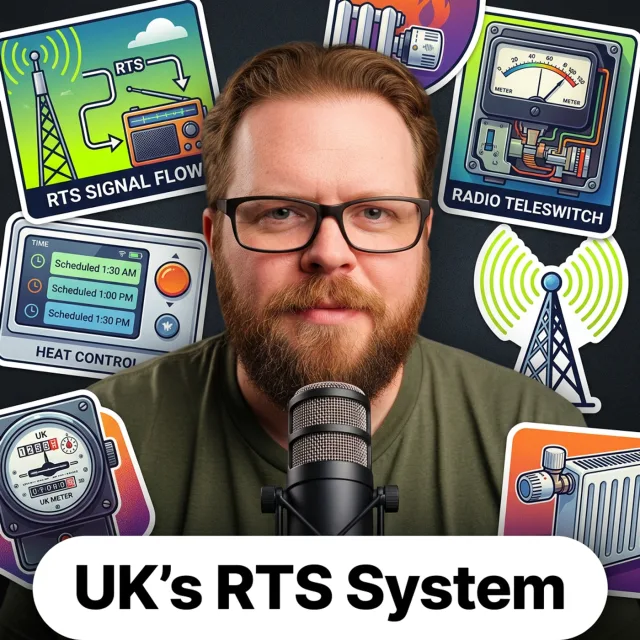
EP 27: HOW A UK RADIO BROADCAST CONTROLS HOUSEHOLD HEATING
DESCRIPTION
For over 40 years, a radio signal in the UK has been quietly switching household heating systems on and off. It's called the Radio Teleswitch Service, and it's one of the best examples of hidden data riding on broadcast signals that most people have never heard of.
I explain how RTS works, how the UK approach compares to what we do in the US, and what it means that the whole thing is finally shutting down after four decades of just working.
TRANSCRIPT — EP 27
So somebody left a comment on the TWP Facebook page this week and I had to admit in public that I had no idea what they were talking about. The comment was about radio carrying a hidden data signal and the commenter mentioned a system called RTS that I had never heard of. I had to go look it up. I've You know, I've been doing broadcast engineering my whole career, but I've only ever worked in U S radio and this is a UK system. So if you're listening from the UK and this all sounds like old news to you, I get it. This is
me doing my homework in public. This is the Tyler Woodward project and today I'm talking about a system that has been running invisibly inside of a radio broadcast since the 1980s Controlling hundreds of thousands of people's homes, you know, they're home heating overnight and I'm covering it now because The BBC just confirmed a shutdown date of June 27th 2026 about five weeks from now. Opinions are my own and if I get something wrong about how things work over there, please leave a comment because that's
apparently how I learn things now. The system is called the Radio Teleswitch Service, RTS. It's British. And the basic idea is exactly what it sounds like. It uses a radio signal to flip a switch. Here's the backstory. In the early 1980s, the UK had a popular electricity deal called economy seven. You get cheaper rates overnight and people would run their storage heaters and hot water on the cheaper nighttime rate. Then coast through the day on the heat they'd built
up. Good deal if you could get it. The problem is you need something to tell your electricity meter when the cheap hours start and stop. The old answer was a mechanical timer, which works until you want to change the schedule or adjust it seasonally. or respond to what's actually happening on the grid that night. Mechanical timers don't care about any of that, they just tick along. So, someone at the BBC in the energy industry figured out they could encode a control signal inside an existing radio broadcast. The
BBC had been running a powerful long -wave transmitter in the English Midlands since 1934. It covers the whole country. It's already paid for, and it's been reliable for 50 -some odd years. Why build new infrastructure when you can piggyback on something that's already there? I should say, just for context, that longwave broadcasting isn't really a thing in the US, we don't have it. So when I'm talking about BBC Radio 4 running on longwave, that's a different part of the radio
spectrum than what we Americans think of as AM radio. Same general idea, just... lower frequencies, which means the signal travels much further. One transmitter covering an entire country is actually pretty realistic at those wavelengths. The clever part is that the data signal was invisible. The radio broadcast kept running exactly as normal. Listeners heard radio 4. Same as always but hidden inside the signal there was a very slow stream
of data being transmitted not audio data control data instructions Little boxes mounted next to the Electrical meter all across the UK were listening for those instructions when the signal said cheap rate The box switched the meter. When it said back to normal, it switched back. The household never touched anything. The utility never had to call anybody. It just happened automatically every night controlled by a radio station. The BBC tested it carefully to make sure it didn't
affect the actual audio in any way. And it didn't. Nobody listening to radio ever knew the signal was there. If you want a rough analogy for what this kind of thing feels like, think about DTMF tones. Those are the tones your phone makes when you press a number, you know, old school touch tone phones, not cell phones. That's just data too. It's just audible. You can hear it happening. The RTS signal was the invisible version of that,
if you will. Closer to how old dial -up modems or pager networks sent data. Encoded in a way that blends into the signal rather than sitting on top of it. The difference with RTS from what I could find is it was doing that inside of a live national radio broadcast for 40 years without anyone ever noticing. They won a major technology award for it in 1987, which makes sense. It's a elegant solution to a real problem. pretty awesome, and it cost almost nothing to build
because most of the infrastructure, it already existed. So the obvious question, at least for me, was, do we have anything like this in the US? And from what I found, we got there a little differently. American utilities have been working on the same basic problem for decades. How do you manage demand? Well, how do you get people to use less electricity during peak hours without just raising prices and hoping for the best? Their early approach here in the states was called AMR, automated meter reading, which is exactly
what it sounds like. A utility truck drives down your street, a radio signal pings your meter, and the meter reports back your overall usage. It was only one way. The meter talked to the truck. The truck, it didn't talk back. That evolved into what we now call AMI. Advanced Metering Infrastructure. Smart meters. Two -way communication. The utility can read your meter. but it can also send commands over to it. That's how things like time of use pricing works over here. Where your
rate is cheaper at 2 a .m. than it is at 6 p .m., the meter knows what time it is and charges you accordingly. No radio broadcast involved with that one. No hidden data signal, just cell or mesh radio networks talking. directly to each other. The difference is the approach. The UK built one giant ass transmitter piggybacked a control signal onto a national radio broadcast and managed hundreds of thousands of electrical meters all at the same time simultaneously with
a single broadcast one signal that went out no signal back very simple very cheap The US built individual two -way communication systems, but at scale every meter is its own node more complex more expensive to roll out and more things to go wrong, but also more flexible and guess a little more precise. Neither one is really any better than the other. They were solving the same problem with different tools and different
infrastructures on hand. The BBC happened to have a 500 kilowatt transmitter that had been running since 1934. American utilities had a fragmented privately owned grid with no equivalent centralized radio broadcast to borrow from. So we built something new. They used what was already there. The system has been running for over 40 years and it's finally shutting down. The transmitter itself is old equipment that runs on old components that aren't made anymore. When something breaks, you find a spare. Eventually you run out of spares.
They're there at this point. The plan was to shut it all down back in June of last year. That didn't happen. It turned out hundreds of thousands of households in the UK still had the old meters running. That depended on the radio signal. The smart meter replacements which use cell networks instead of radio weren't going out fast enough Scotland was especially behind partly because of You know a lot of those homes are in remote areas where getting someone out to swap a meter is a little bit bigger of a lift The shutdown date got pushed back once then again Two weeks
ago, the BBC finally put out a hard date on it. June 27th, 2026. This year. And I'm just now learning about this. There's one more detail here that I thought was really interesting. There's actually a rule that says the transmitter can't just run the hidden data signal by itself with no radio programming. Attached to it. So the broadcast has to be there, too So when radio 4 goes off longwave the control signal has to go with it They're the same thing The news story about radio 4's shutdown in the energy story
about the meter system shutting down or not really two separate events. It's all one one switch off I didn't know any of this until A Facebook comment taught me. Finally, something good came out of Facebook instead of the other garbage I typically get on there. This was cool. I learned something from somebody just commenting about my last video about AM not having RDS. They're like, Hey, over here, we do this. There's a lot of infrastructure out there like this systems that do real unglamorous important work invisibly for decades inside something else people think
they already understood a Radio station that's been switching people's heating on and off every night since before some of those people were probably ever born Nobody was taught about it. It just ran Now it's stopping mostly because the hardware finally get too old to fix I Don't know how many other things like this are out there, but probably more than We'd expect This is the Tyler woodward project links in the show notes listen at Tyler woodward .me slash podcast Make sure you also subscribe Tyler woodward .me slash subscribe you can Find me on Instagram, blueskyandthreads at tylerwoodward .me and subscribe,
like the show, leave a rating and review if you feel so inclined at Apple podcast and Spotify especially. I'll catch you next week.