EP 30: HD RADIO HIJACKING: WHEN BIG STATIONS STEAL YOUR FREQUENCY
DESCRIPTION
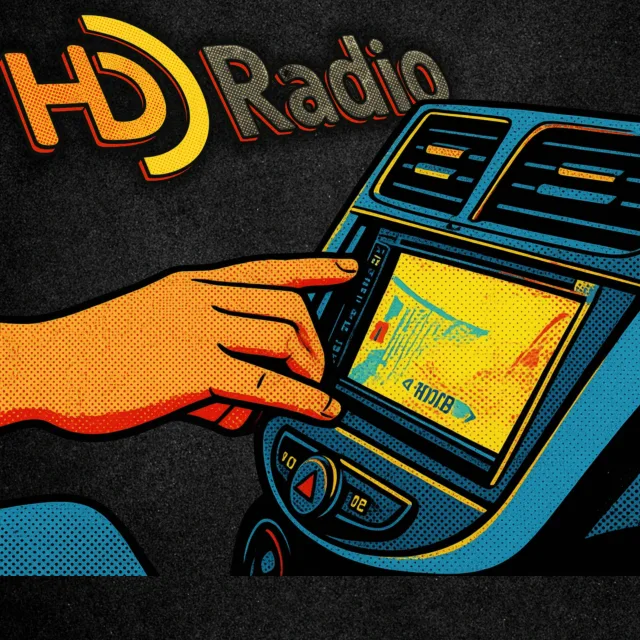
HD radio hijacking happens when a distant station's digital signal takes over a local frequency the moment that local station's own HD signal goes dark. Tyler breaks down how this happened to him on his commute, why small and low power FM stations have zero regulatory protection against it, and how outdated FCC rules let bigger broadcasters with more transmitter power dominate the dial. It's a case study in how spectrum rules built for analog radio quietly favor consolidation over local, independent stations.
TRANSCRIPT — EP 30
So I was driving into work one morning along the Mississippi running that, you know, that stretch that's between Wisconsin and Minnesota. Normal commute radio on as usual, because, you know, I got to monitor the station I work for. And at some point I realized I wasn't listening to my my local station anymore. I was listening to KFAI out of Minneapolis 90 .3 FM about 180 miles north it was on the same frequency KFAI was running in HD and the transmitter for my
local 90 .3 had recently shut its HD down so the receiver found the only signal The only digital signal it could on that frequency It grabbed it and it played Minneapolis KFA I Now I'm a broadcast engineer. I knew about HD radio Hijacking, you know, I knew what it was before That event took place that morning. I heard about it, you know through presentations at the WBA broadcasters clinic. I understood how it works, the concept,
and I still sat there in my car for a second going, wait, hang on, that's not right. The gap between knowing how something works and having it happen to you in real life is where this episode is going to live. This is the Tyler Woodward project. I'm Tyler Woodward and today I'm talking about HD radio the HD radio digital capture or HD radio Hijacking as some people call it, you know what it is why it actually happens and what it means for any station that doesn't have a digital signal defending its frequency Quick disclaimer as usual though everything here is
from my own point of view Not the position of any station I work for or any organization that I'm affiliated with These are my opinions from my point of view For folks that don't work in the engineering side of radio or you know want to peek behind the curtain, this is how it works HD radio is a hybrid system. A radio station keeps its regular analog FM signal that it's always had, but it also transmits a set of digital carriers right alongside it, on the same channel, not a separate frequency, right there, on both sides of the analog signal. Like, parentheses,
I guess is the best way I can put that, gives you a visual. The digital carriers run at a fraction of the analog power at standard levels roughly 1 % of what the analog transmitter itself is putting out. The pitch when this system was designed was that the digital would be quiet enough to be invisible to receivers that couldn't read it. loud enough that HD capable receivers could lock on to that signal. An HD radio receiver is designed to prefer the digital signal over the analog signal. That preference is the feature.
Digital obviously sounds a little better. It's cleaner, no static, no multi -path issues, and that's the whole argument for the system. So the receiver looks for Digital first over the analog Now if it finds the digital carrier on that frequency it locks on It doesn't check whether that digital signal is from your local station. It just latches on to it So when my local 90 .3 had its HD running my receiver grabbed it from my local stations digital signal Fine, it worked as designed. That's how it's supposed to work the moment though that by 90 .3 shut its HD down while the local digital signal was
gone and KFAI's HD1 signal 180 miles north on the same frequency was sitting right there waiting for someone to grab it. My receiver found it. It locked on and played me Minneapolis for the drive in. I knew the HD was off. I had not fully thought through what that meant for the morning commute until that happened that very morning. Let's talk about co -channel stations. Two stations on the same frequency in different cities. They're protected from each other by distance. The FCC spaces them out just far enough that in normal analog propagation, The weaker signal fades before
it reaches the other station's listeners. That math, I mean, it's worked for decades. It's built for, lack of a better word, the analog era. An HD receiver, it's not comparing analog field strengths, it's looking for that digital carrier sitting out there in the open. And a digital carrier travels differently than the analog signal strength. a powerful station running HD can extend its digital influence further into the surrounding territory than the traditional co -channel protection distance assumes in the rule book, especially
when the local station isn't running HD at all, which was in my case. No local digital signal means no competition to fight. fight off that intruding HD1. The receiver finds whatever digital signal it can reach on that frequency and that's what you're going to hear. Now, I should point out that in my vehicle, my Subaru Forester, when I lost my 90 .3 and locked on to 90 .3 Out of the cities that was broadcasting HD1, one option I do have in my vehicle is I can turn HD radio off. There is a button to disable HD radio. So
I could turn it off and go right back to my local 90 .3. But think of this coming from a, you know, a regular everyday person who just wants to listen to the radio on their way in to work on their commute. They may not know that and now you've accidentally lost the listener that latched on to someone else's HD1. A broadcast consultant did modeling on this for NPR labs. He worked out the field strength threshold at which a distant co -channel station's digital signal crosses into capture territory, the hijacking territory
around You know he estimated around 35 to 40 micro volts per meter that really gets into the nerdy stuff that I'm not really gonna get into on this episode But if a listener is inside that window and a local station isn't running HD the distance station gets the listener So my drive along the Mississippi that morning put me squarely in that window And we should point out, my situation is not unusual. There's a small community FM in Asheville, North Carolina, WPVM. It's 100 watts at 103 .7 that has been getting captured by WSOC out of Charlotte for years. Some, the
same frequency, WSOC is 100 ,000 watts, about 100 miles away. The WPVM general manager found out about it in 2021 when she bought a new car with an HD radio tuner. Her screen was showing WSOC's call letters and album art, Charlotte's music, Charlotte's branding on her receiver inside her city. She reported it to radio world. Xpery, the company that owns the HD radio technology said they had received no official report and couldn't comment without one. The Buffalo case is different and maybe more instructive about
the mechanics of this whole thing. WDCX is a big station running HD around Christmas 2022. Their own HD carrier failed. When it did, listeners started picking up a Canadian co -channel station instead. WDCX's own digital signal was the only thing holding the territory against the Canadian station. When the carrier went down, even just briefly, the ground was open for the taken. That's what I was dealing with on a smaller scale on my drive in that chilly fall morning. The moment the local HD went dark, the frequency was up
for grabs, digitally. In KFAI, a legitimate well -run station 180 miles away didn't do anything wrong. Their signal was just there. The receiver found it and locked onto it exactly what it was supposed to be doing. The problem here is more to do with the math. The WSOC's digital sidebands at let's say standard injection levels are putting out roughly maybe a thousand watts of digital energy. That is 10 times WPVM's entire transmitter output. And my local situation is not, you know,
not that extreme compared to that. KFAI is it's a community station, not a clear channel giant, but the principle behind this is the same. A station with more transmitter power has more digital territory. A station with no HD has zilch, nothing, nada. The FCC has been moving in one direction on this. In 2010, they... they raised the allowed HD digital power ceiling. In late 2024, they approved asymmetric sideband operation, which let stations run more digital power on one side of their channel than the other. Every
one of these decisions benefits stations with the capital to upgrade their transmission system and equipment over to digital. Now let's talk about the low power FM's the LP FM's they can't run HD Most community stations can't run HD the equipment costs. I mean, that's a struggle the engineering requirements and the know -how to operate it is real so they show up to the frequency without a digital signal and Literally have no protection against the station that does the FCC They've received hundreds of I Bach interference complaints since HD radio launched They have
never acted on a single one that I could find Now here's what I keep coming back to KFA I They didn't do anything wrong. All right, so let me set the record straight. They didn't do anything wrong my car It didn't malfunction The receiver did exactly what it was designed to do nobody in this story is the bad guy What the story is about is what happens when you design a standard around the broadcasters funding its development Approve it without competitive evaluation and then slowly expand its power ceiling for decades while the secondary services it disadvantages
have no regulatory path to complain or object. HD radio was selected by the FCC back in 2002 as the de facto U .S. digital radio standard. One company's proprietary system, iBiquity, now Xpery, backed by the major broadcast groups. The major broadcast groups, they ran pilots. The system got built around their infrastructure and their power levels. LP FM stations are considered secondary services. That is a specific regulatory category that means basically you get what's left over and you don't get the file complaints
against the primary services. The interference rules in this area were written for analog to analog scenarios. And I mean, they don't cross over onto the digital capture slash hijacking, which is an interference in the traditional sense, I guess. The receiver is working correctly, but that also is exactly the problem. I knew that morning that our HD was off. That wasn't a me decision. That was a company decision was to shut the HD radio service down. What I didn't think about, but you know, I heard at you know, conferences like WBA and through trade magazines
and publications that HD radio hijacking was real. But I hadn't thought through what it meant for that little Minneapolis community station that was going to be sitting on that frequency digitally for anyone in my position driving along the river. And maybe we should have. I mean, we know this stuff. We just didn't think that morning with ducting or whatever that KFAI would come in to interfere with my local 90 .3. It really caught me off guard because I had heard of the concept. I have heard of hijacking, but never experienced it. The listeners who don't think about this at all have no idea what's happening
to them. They're wondering where their local public radio station went. The WPVM general manager Found out because she bought a new car. Most LPFM managers didn't get that prompt. There's people in Asheville right now hearing Charlotte and not knowing it. There's no form to file for them though. Nothing goes anywhere. The system is doing exactly what it was supposed to do. So what all clothes on is this? for the LPFMs who can't do digital. Unfortunately, there's not a whole lot you can do right now, but advocate for turning on digital. But for full power primary
stations who are not at least running an HD1, I would reconsider that. If anything, if you have no desire, no plan, no thoughts on ever running any additional content channels in HD2 or in HD3. I mean, at least having HD1 on your primary station protects you from this HD radio hijacking slash HD radio capturing. It protects your contour from unfortunate digital quote unquote digital interference. So if anything, I would look into at least putting HD1 on the primary.
If for no other reason other than it sounds better, it looks better in your listener's dash and well, protects you from the HD radio hijack. Make sure you subscribe over on Apple Podcasts, Spotify, or even iHeartRadio, rate and review the show. Follow me on Facebook and YouTube at The Tyler Woodward Project, Instagram, threads, blue sky. I'm over there too, at Tyler Woodward dot me, reach out and say, Hey, hit me up with any ideas on some content. And, uh, well also subscribe to the sub stack at sub stack dot Tyler Woodward dot me. I'm all independent. This is my thing. I don't have any sponsors. So if you like the show, show some love or just share it and subscribe
to the podcast as well. That's it for me this week. I will catch you guys on the next one.