
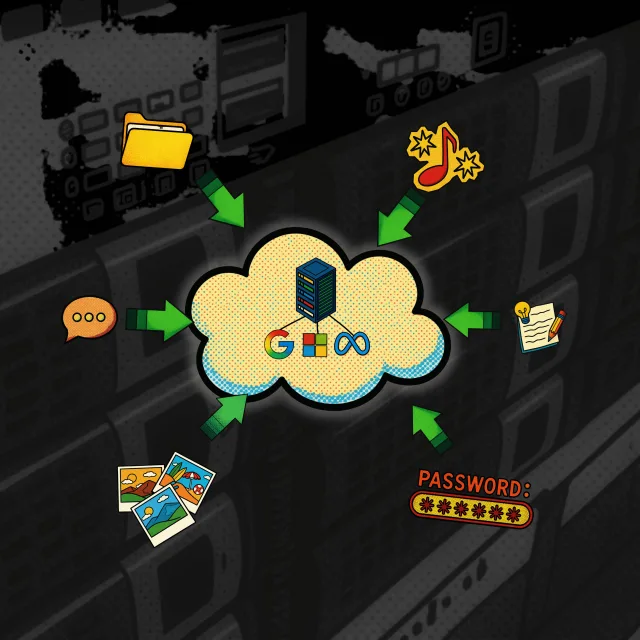
Stop renting your own life back from Google, Apple, and Meta
Everyone repeats the line that the cloud is just someone else's computer, and then keeps handing over their whole life to it anyway. I get into what that actually means once you stop laughing at it: they write the rules, they change them whenever they want, and they can lock you out of your own photos and emails without warning.
I walk through what Google, Microsoft, Meta, and Apple actually do with your data versus what people assume, then break down the 2022 LastPass breach as the clearest example of what happens when everyone's information gets piled into one company's server. From there I get into what self hosting actually looks like now, from a box on a shelf in your house to a rented VPS, plus tools like Vaultwarden and Immich ("Image") that let you run your own passwords and photos without handing them over to a corporation.
This isn't a burn it all down pitch. I still use iCloud myself and I say so. It's a real look at how much control you're giving away by default and what it would actually take to get some of it back, which is exactly what digital ownership and tech accountability are supposed to be about.
There's this line that gets thrown around a lot, you know, the cloud is someone else's computer and everyone kind of sort of gets that I mean your data, you know, your your files your Photos your bank statements your tax records, whatever that you might that you may have sitting out there on the cloud It's you know, it's not some random guy's Basement on his computer or something. It's on a company a corporate server, you know Google or Microsoft or Apple, you know, it's on one of their systems but essentially it's the same thing your data is on someone else's
hardware and You know, I I think we need to talk about that. We need to kind of sit here and think about that because I mean are there alternatives than just you know other than putting your whole life out there on the internet somewhere on someone else's server I mean because it's true and once you start peeling the label back man it's hard to unsee it I'm Tyler. Thanks for being here. This is the Tyler Woodward Project. And today, well, we're going to talk about that line, that
your data, you know, your stuff in the cloud is on someone else's computer. And, you know, about pulling your personal data back off of those computers and putting that onto systems that you own. your own hardware or at least Hardware that you lease and control that you have the root privileges for And like always This is always my read on it my opinions you can take it or leave it you know the rest of what I do is over
at Tyler Woodward dot me and before I get going I'm not going to stand here and pretend I've got all this figured out. Right now, today, half of my life is still sitting out there on Apple servers and probably a little bit on Google. I use iCloud. I've got a MacBook Neo. I've got an iPhone. My kids got iPads. My wife's got an iPhone. you know, all of our stuff's out there on iCloud. I pay for the extra iCloud storage so we can back all those devices up. And I'm working on it. I'm trying to not rely on that
so much. I'm trying to take a, I don't know, a measured approach to keeping my stuff off of there. So, you know, this isn't a lecture from a guy on the other side. I'm just another dude out there in the middle of it, just thinking about this out loud. And hopefully maybe I can spark some interest in some of you to rethink what we're putting out there in the world. So let's talk about the part Nobody's really arguing with about anymore Your whole life a good chunk
of it probably by this point is sitting on their computers and the fine print it Sorta allows them to do a lot with that data. I Want to be fair here because a couple of these lines They're real they're facts now Google says it doesn't train its AI on your Gmail, and it doesn't scan your drive to sell you ads. And as far as anyone can tell, that's true. I mean, take it with a grain of salt. I don't trust the big corporate overlords with the data anymore. It's kind of
a murky area, but we'll move on. Microsoft, that's another one. Microsoft had a whole panic a while back about it feeding your Word documents into its AI. Copilot. And when people started actually digging into it, well, that sort of fell apart. It didn't hold any water, or as far as we can tell, it's not true. But then there's Meta, which in 2024 changed the rules so your public Facebook and Instagram posts and your photos train their
AI straight up. Now, they paused it in Europe when regulators called them out on it and started pressuring them. And then they flipped it back on over there in 2025. So, you know here in the States We don't have the same Set of data protections that they have over there in Europe now It would be a whole other argument on another episode I really think we should have probably, you know, probably adopt some of those but you know, you got the lobbyist out there Waving all the money around so they don't actually pass any any real, you know concrete data protection laws for us,
but Like I said, that's a whole another episode Here in the States There's basically no opting out of out of what they collect over here either so You know, it's it's a mixed bag and I'm not gonna tell you All three are reading every word you type, because that's not really it. What's true, though, is simpler. It is their machine. The terms let them do what they want. The defaults lean toward yes. And your stuff gets scanned
and sorted all day just to run their product. Now that part it's not a conspiracy. That's just a normal Tuesday Now I'm not here to make you feel bad about putting all your data out there on Google or Microsoft or Apple meta, whatever I'm here because I think The usual conversation about it is a dead end people argue about whether you should trust these companies whether they're you know, the privacy policies are fair, whether you've got anything to hide. And I think that whole frame is a trap in itself. The question
was never whether you trust them. The question is why you're handing them your data at all. Because here's what, quote, someone else's computer actually means once you stop kind of chuckling about that line when it's their computer they make the rules they change them whenever they want and you find out usually afterwards or months maybe a year down the line when some security researcher uncovers it because they didn't publicly disclose it Meta has done that a few times. But
again, they make the rules. They change them whenever they want. And again, you may find out afterwards. They can decide your account is done and lock you out of your own photos, your own email, years and years of your life. And there's no one to call. You were a guest in their sandbox. They can lock that door on you whenever they want. And then, you know, and then there's one more piece of that, the big one. When the government
comes asking, they're the ones who answer, not you. And the ones answering? I'm talking about Microsoft and Apple and Meta and Google and all these other big tech conglomerates. Meta's own transparency report says it got over 320 ,000 government requests for user data in just the first half of 2024 alone. And three quarters of the U .S. The ones that come from the US came with a gag order. So they legally couldn't even tell you it happened. One study found Google,
Meta, and Apple handed US authorities data on more than three and a half million accounts over about a decade. I mean... You can't you can't hand over What you don't hold So sit with that one because it's basically where the show is going right now Let me give you the Clearest example of why this setup is actually a problem, you know, not just bashing the companies who
run it. Let's talk about LastPass. LastPass, if you've never heard of them, they're a password manager company. I mean, I think they do a few other things, but their bread and butter is password management. Millions of users back in 2022, LastPass got broken into. And the thing that got taken wasn't, you know, one person's passwords, it was a backup of the entire vault database. Everybody's. Every last pass customers encrypted vault sitting
together in one single cloud bucket, copied and they walked right out the door in one single breach. Now, Credit, where credit is due, the actual passwords inside those vaults, as I mentioned a minute ago, they were encrypted. Locked behind each person's master password. A master password, if you've never used a password manager before, is the password to get you in the door to get to all the other passwords that you have saved in there. you know a password manager you only have to remember one password instead of 300
different ones is essentially what a master password is but the master passwords last pass they don't store those so getting the vault i mean yeah they got the vault but they couldn't read the vault without that password now if your master password was long and weird and unique, your stuff is probably good. You're probably fine. But two things. One, sitting right next to that encryption, not encrypted at all, was your email, your billing address, your phone number, and
every single website you'd ever saved a login for. Yeah, they may not have that password, but they know where you've been That part was just readable for everybody no master password required in two If your master password Wasn't great You know wasn't strong wasn't 15 plus characters with Special characters and hieroglyphics and the blood of your firstborn The attacker I mean They possibly could have cracked it They could
have got in the door forever no rate limit no lockout no way for you to even know That that they ever get into it because it was all offline once they grabbed it People are still getting crypto wallets drained today from vaults that were stolen back in 2022 now the other part i want you to take away from this is uh you know one break -in got everybody and the only reason one break -in could get everybody is that everybody's data was piled into the same bucket the same place on the same company server that pile is
what makes it worth attacking I mean right if all your data is there they only got to go to one spot it's a pretty good attack surface you you know out there hosting your own stuff on your own box I mean you're just a one person and a see the digital abyss Now, I'm not saying that makes you safe, but it makes you less of a target. You know, you're just one boring target out of millions, not really a jackpot. So, you know, that's the pitch. Stop putting the crown jewels out there on other people's computers.
Put all of your, you know, put your eggs in your own basket. And I know how that sounds. So, you know, let me be let me be a little honest with you Because a sharp person is already ahead of me here. I know someone's probably already banging on the keyboard typing in the comments When I say host it yourself There is a spectrum of what that means One end is a machine in your own damn house on your own shelf on your own desk your own little NAS, a little box and a closet. You know, that's that's completely yours. The other
end is renting a, you know, a virtual server, a VPS virtual private server, which, yes, is technically still someone else's computer. Fair. I will give you that, but it's a different animal. You're renting the bare metal running your own software putting your own encrypted stuff on it and their business is renting you the metal not reading what you store in your little slice of of the uh the data center you have the root credentials it's yours you're running it until you decide to quit paying that bill or delete that server it's it's yours now I mean it's not
perfect, but it's a long way from handing Google the keys to the kingdom. Okay, so What do you actually run? This stuff is real it works and most people have no idea how far it has come You know, let's talk about passwords vault warding
It works with all the normal bit warden apps bit warden is like last pass They're they're a password manager except With Volt Warden, it's a copy that you run, but you can still use the official Bitwarden apps to get to your passwords, your notes, your encrypted files and whatever you store on there. The Volt through Volt Warden lives on your machine, not the company's. So your blast radius is only you. Not everybody else not all million other plus people the other one is photos This one That you know, this is
the one that gets the people I'm itch. I Think I pronounced that right. What is it? I am ICH I'm Mitch That's how I've been saying it. I'm probably wrong. Tell me how you would pronounce it or the the correct way It does basically everything that Google Photos does. The auto -backup, the face recognition, search your library for the dog or for a beach or your grandmother, all of it. Except it runs on your own hardware and nothing gets uploaded anywhere for an AI model to learn from. Once you see it running, I mean, it's hard
to believe that, you know, that's real, but it is. Try it, run it, spin it up. The other one is files. That sweet spot for Google Drive or Dropbox or Box .com, one of those. You can run Nextcloud or Owncloud, either one of those. Your documents sync across your devices. They're just not sitting in a system that might quietly start feeding it when they decide to change that privacy policy to train their AI models on. Using Nextcloud or own cloud, well, you control that data. And if you didn't want to use iMitch or Vault Warden,
the other nice benefit of Nextcloud or own cloud is There's, there's plugins, there's modules. You can tack onto it. You can, you can use an X cloud or own cloud to put your, your photos or your passwords, or you could even, I mean, you can even use it to run your email through and notes and do teams call it. Well, not teams, Microsoft teams, but you know, video calls and chats and other things like that. If you ran it for a business, or even if you just wanted to do it for your family, I mean, next cloud. and own cloud they're very powerful tools and they're free you can host them yourself right now you can go pay 20 bucks a month for a vps out there and control it or you know you get
yourself a decent used computer with a good size drive you know maybe 16 gigs of ram doesn't have to be ddr5 what's overly priced right now you could set that up at home use a dynamic dns if you don't get a static ip at home bam you're set man And the other benefit of next cloud and own cloud is your documents sync across all your devices, just like Google, just like Apple, just like Microsoft's OneDrive. You know, again, they're not just sitting in a system that might quietly start feeding them into next year's AI. And then my favorite. Because this one is so fucking stupid.
Your own TV shows Plex Yeah Plex used to be the gold standard here For years the app that made a pile of your own video files feel like a real state -of -the -art streaming service Well That was true and till they Decided they wanted you know they wanted to and shitify their own damn product because that seems to be what everybody's doing now and that's i mean that's not me being cute go google it all the crap that plex has been pulling and that's a real word for it if you've never heard of in shitification go look
it up corey doctorow awesome book go look that up plex they make you log into your own account even to watch a file on your own hard drive, on your own network that could be sitting on a computer across the room from you. Your watch history routes through their servers. And this year, back in July of 2026, they tripled the price of their lifetime pass. to like $749 and
started charging just to watch your own server when you're away from home. Previously, before that, even if you were a free Plex subscriber, I think it was free, or at least, you know, Plex pass, you could take your media. Well, no, it had to be free because they started charging for it. That was the whole point of that comment, I guess. I'm an idiot. Don't... ignore me um but you could at least take your own media files and watch them wherever you want on your phone you know taking your apple tv with you your roku stick into a hotel you could watch it i mean you had to play you had to pay for plex pass for sure if you wanted to take like an hd home run and have local tv like transcoding and the
dvr features and all that stuff i know you had to pay for that which is why i'm a plex pass member because I have an HD home run taking my local ATSC feeds and yeah, I got a nice pretty electronic program guide with it. That part is still genuinely useful with Plex, but the tripling of the price and scaling it back. So you got to pay in order to watch just your own local stuff that's right there at home because everything's got to traverse through the Plex servers. I mean, it might be a strong piece of language here, but fuck Plex for that one. Honestly, I mean, come on. Now, what's the alternative to Plex?
Well, you got Jellyfin. That's an open standard now, forked off a media server that went proprietary back in 2018. You want to know what's awesome about Jellyfin? You don't need an account. It doesn't need the phone home, zero telemetry, And that's by design. It's not a setting you have to dig for. It just serves your movies, your TV shows, whatever, to your devices and stays out of your business. And it keeps going. I got a whole list of other tools here. You got Trillium, Outline, a little tool called Memos, all self -hosted. So the text stays on a file on your machine instead of... getting shipped off to some AI sub processor the instant you
touch a smart feature. If you've never looked up memos or outline or Trillium, very, very good note taking tools. Now I, I like Obsidian. Obsidian I run because everything is stored and marked down files on my machine. I pay for their sync service, which is like Don't know if it's five or ten bucks a month, but it sinks it between my devices, but it doesn't sit on their servers So that's another one you could use Let's talk about your group chats, you know things that are gonna get you off of discord Matrix That's
self -hostable. I ran one of those for a little while didn't find a use for it shut it down, but that's a good option and the other benefit of matrix is it is end -to -end encrypted and this isn't just you know fringe hobbyists type stuff it's what chunks of the french and german governments run their own internal messaging on so i mean it's got the check mark for the government usage and the reason they moved all their messaging and chats over there is because they got nervous about what the American companies, the Googles, the Microsofts were doing before we even noticed. Your project boards. Let's talk
about that. Your Trilio, your Asana focal board does all that. Though, you know, I'm going to be straight with you. It's not getting much active development right now. So, you know, go in eyes open on that one. Careful and remote desktop You know to get you away from team viewer those sort of tools. There's rest desk where the connection between your two machines Never has to touch a stranger's relay server It's all yours. I Mean I gave you a lot of tools there. I rattled off a lot You don't have to do all of that at once
And I think that's the pitfall a lot of people make when they dive head -first into self -hosting. They try to run everything. No, just pick one tool. Pick a Nexcloud or Jellyfin or Memos. Just pick a couple. Because, yeah, looking at that list and deciding it's going to be another job for you, that's not what I want to do. Just pick one, start there. Now a few other things we got to cover. One, none of this is about being paranoid. And it's definitely not, you know, trying to think of the best way to say this, it's definitely not about having something to hide. It's not,
you know, it's about not leaving your front door open just because nobody's walked in yet. Your stuff, Being private is sort of kind of this default you're supposed to get or at least I feel it should. If you're gonna trust someone with your personal data, your photos, your files, whatever they, excuse me, whatever they are, you should at least have some sense that your data is protected and is not going to be used against you or used to feed some AI model. I
feel like that's nice default to have, right? You shouldn't have to earn that back. And again, if we here in the United States had good privacy data laws like Europe, we wouldn't be having this conversation. Now another, This isn't you Against the security team. Nobody's saying you'll Defend your box better than Google defends theirs because I know there's gonna be the security people out there the point is When it's yours yours your one Small target and when it's theirs your one entry in a pile worth of fortune to
crack now You still gotta protect your stuff. You still gotta take basic measures. We're not covering all that today. I'm just giving you some options that you can use if you wanted to self -host some of your own goodies, your own passwords, your own photos, your own files. We can get into a whole other list of the security stuff in a different episode. One other. Start with the one that bugs you the most. photos for a lot of people because Obviously photos. That's the personal one. You know your kids your Relatives, maybe your your parents or your grandparents who have passed away and you have those Those
those memories those photos that are cherished and you don't want to lose those That's the one That I think people should start with Get that off of someone else's computer and on to yours and just notice how it feels to know exactly where it's living. You know, because right now it syncs up. Nobody really thinks about it. But the other thing that the likes of Google are doing is, you know, they're cutting back on the storage they give you. And the Gmail users, they found that out the hard way. Inboxes started filling up, realized that, hey, Data that storage
that's getting pricey nowadays because of AI So these companies have to dial it back just like everybody else is having to and There was another point I was gonna make and I completely blanked on it now Yeah, I just had a brain fart in the middle of recording this oh well, I'm sure I'll Remember it as soon as I'm done with this episode Now coming back full circle, you know the cloud it's someone else's computer That's the whole thing It's it's not evil. It's just true and you're allowed to decide you'd rather Have it be on your own system your own hardware
in your own house on your own internet connection Or if you want to go to VPS route on a trusted server that you hold the root credentials for I Remember what I was gonna say now Remember that if the product is Or I should say if the service is free You are the product Remember that that's the show it was a long one we're passing like 33 minutes right now if you want to keep up with it subscribe wherever you might be listening and if you've got a second drop a five star rating on apple podcast spotify youtube music wherever you're listening and if you'd rather just talk you can call you can leave a voicemail or you can text me 608 -668 -4702 again
608 -668 For 702 you can leave a voicemail or you can text that number and hey who knows I might read it or play it on the next show And if you want to buy me a cup of coffee just to say thanks for doing this you can do that over at Tyler Woodward dot me That's it. It's all I got for you. I'll catch you guys next week